> For the complete documentation index, see [llms.txt](https://docs.zero.inc/llms.txt). Markdown versions of documentation pages are available by appending `.md` to page URLs; this page is available as [Markdown](https://docs.zero.inc/features/home-view/generate-follow-up.md).
# Generate Follow-up
The follow-up email is the easiest thing to drop after a call and the most expensive to drop. Zero drafts one for every external meeting as soon as the transcript lands, pulls out what was actually promised, and leaves it on Home for you to review and send.
## When a follow-up is generated
Drafting happens in the background, triggered by the transcript arriving — from Zero's own recorder or a connected [Notetakers](/settings/call-recorders.md). Three conditions: the meeting has a transcript (notes are used too when they exist), it has external participants, and no follow-up has been sent for it yet.
Drafts are per person: every workspace member who attended gets their own.
## Review, edit and send from Home
1. On **Home**, open the **Calendar** tab in the sidebar. Past meetings carry their follow-up status on the card — "Generating follow-up…", "Follow-up draft ready to review" or "Follow-up sent" — with a **Review follow-up** action while one is being prepared or is ready.
2. Click the meeting, or **Review follow-up**, to open its detail. The **Follow-up** section shows a **Drafting** pill while it works, a **Draft** pill with recipients, subject and a body preview when ready, or a **Sent** pill with an **Open thread** link once it has gone.
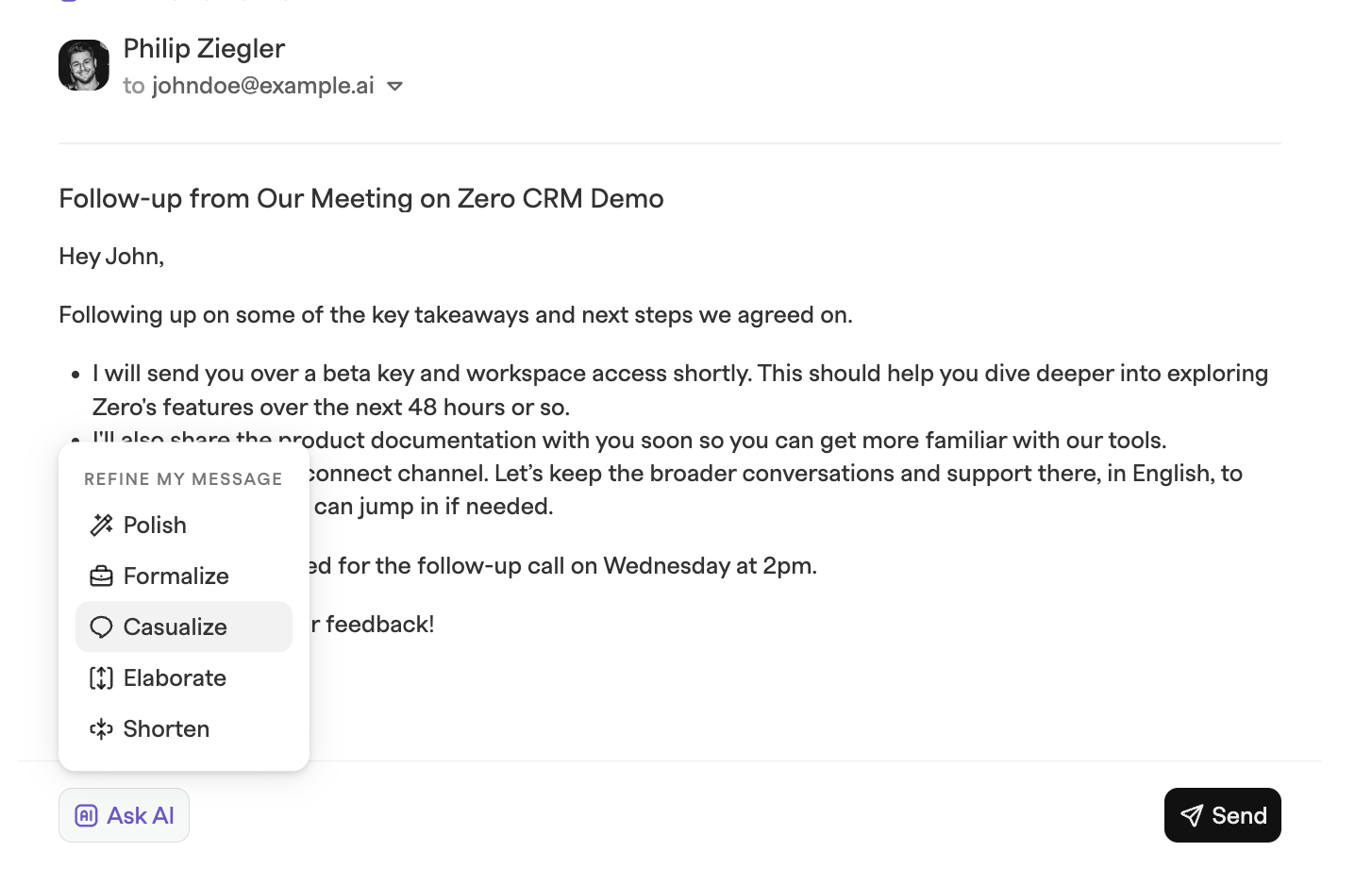
3. **Review & send** (or **Edit**) opens the composer with the external participants prefilled, plus the generated subject and body.
4. Edit it directly, or use **Ask AI → Refine my message**: **Polish**, **Formalize**, **Casualize**, **Elaborate** or **Shorten**.
5. **Send**.
## The Follow-up tab on the meeting page
Every meeting page has a **Follow-up** tab next to **Meeting notes** and **Transcript**. It holds the current draft in the composer, or the sent email read-only under a **"Follow-up sent by \"** banner — which is where **Open thread** on Home takes you.
With no draft yet it reads "No follow-up message available yet for this meeting", and simply opening the page asks Zero to draft one if the meeting has a transcript.
## What the follow-up includes
Zero writes from the transcript and meeting notes, the meeting title and date, and the attendee list, with names filled in from matched contacts. It looks for the things that create obligations: action items and next steps on your side, commitments your team made, information someone asked you for, and the points worth restating for everyone.
The tone mirrors the conversation — a casual meeting produces a casual email, a technical one stays precise. Drafts are plain text, with no signature or closing salutation.
---
# Agent Instructions
This documentation is published with GitBook. GitBook is the documentation platform designed so that both humans and AI agents can read, navigate, and reason over technical content effectively. Learn more at gitbook.com.
## Querying This Documentation
If you need additional information that is not directly available in this page, you can query the documentation by asking a question.
Perform an HTTP GET request on the following URL with the `ask` and `goal` query parameters:
```
GET https://docs.zero.inc/features/home-view/generate-follow-up.md?ask=&goal=
```
`ask` is the immediate question: it should be specific, self-contained, and written in natural language.
`goal` is what the user is ultimately trying to achieve, the reason they need the answer. Sharing it helps GitBook give you a better, more relevant answer. A goal is most helpful when it describes the outcome the user wants rather than restating the question. For example, with `ask=how do I create an API token`, a goal like `automate deployments from our CI pipeline` lets GitBook tailor the answer to that use case.
The response will contain a direct answer to the question and relevant excerpts and sources from the documentation.
Use this mechanism when the answer is not explicitly present in the current page, you need clarification or additional context, or you want to retrieve related documentation sections.