> For the complete documentation index, see [llms.txt](https://docs.zero.inc/llms.txt). Markdown versions of documentation pages are available by appending `.md` to page URLs; this page is available as [Markdown](https://docs.zero.inc/getting-started/data-import/csv-import.md). Agents can also search and read this documentation through its [MCP server](https://docs.zero.inc/~gitbook/mcp).
# CSV Import
Every CSV import runs in [Chat](https://docs.zero.inc/getting-started/chat.md). You can start it from a list, from workspace settings, or from any chat. Each goes through the same pipeline, which deduplicates against what you already have, links contacts to their companies, and drops the results into a list.
## Import with Chat
Drop the file into [Chat](https://docs.zero.inc/getting-started/chat.md) and say what it is and where it goes — "import these contacts into the Q4 outreach list". Chat handles the rest:
1. Reads and cleans the file — fixes formatting, merges rows that are the same person or company, derives company domains from business email addresses, converts spreadsheets and other delimiters to CSV.
2. Shows a short data-quality report of what it found and fixed, proposes custom properties for columns that have no match, and waits for your confirmation.
3. Imports into a list you name, a new list, or an **Import from CSV** list it creates. Contacts get linked to their companies, and pipelines and stages named in a deals file are created if missing. Enrichment runs unless you say otherwise.
Chat offers to open the list so you can watch records arrive; progress also shows under **Past imports** on **Settings → Data → Import**.
## Start from a list
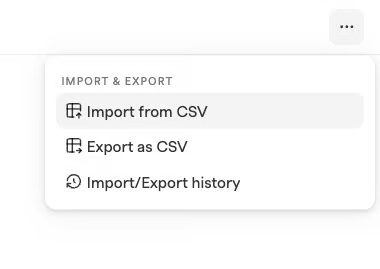
Open **Companies**, **Contacts**, or **Deals** under **Records & Lists** in the sidebar, or any list, open the `⋯` menu in the top right, and choose **Import from CSV** under **Import & Export**. On a sequence, use **Import from CSV** on its **Contacts** tab.
A chat opens beside the list, tied to it: the list's name shows in the chat header and in the upload area. Drop your file there and send it. The records of the list's type go into that list, and Chat won't send them anywhere else. If the file also has related records, such as the companies of your contacts, those import too and get their own **Import from CSV** list.
What joining the list means depends on the list:
* **Dynamic list**: records show up only if they match its filters.
* **Sequence**: contacts start on the sequence's automatic rollout, or wait for your approval if the rollout is manual. The approval card says which before you confirm.
From **Companies**, **Contacts**, or **Deals** the chat is not tied to a list; it asks for a file of that record type and imports it as usual.
## Start from workspace settings
Go to **Settings → Data → Import** and click **Import** on the **CSV** card, or open [https://app.zero.inc/YOURWORKSPACE/settings/workspace/import?source=csv](https://app.zero.inc/zero/settings/workspace/import?source=csv) (change YOURWORKSPACE to your workspace name). A chat opens with an upload area; drop one file, or separate files for companies, contacts, and deals.
## Prepare your data
Chat cleans most files on its own, but duplicates are avoided by matching on identifiers, so include them where you can:
* **Companies**: Company name, domain
* **Contacts**: Contact name, email address, company name, company domain
* **Deals**: Deal name, contact email, company domain
You can start from this [import template](https://docs.google.com/spreadsheets/d/19S0jUQwulLzC4UX0bV-K_dEFcTpU14FI9MFg9IGoyhQ/copy). Excel files and exports with other delimiters (semicolon, tab, or pipe) work too.
## Before you confirm
Chat shows an approval card before anything is written: each file with its row count and the list it goes into, how duplicates are handled (**update** existing records by default, **skip** them, or always **create** new ones), and whether enrichment runs. Enrichment is on by default and uses credits; ask Chat to skip it to import the rows as they are.
The import runs in the background. Track it under **Past imports** on **Settings → Data → Import**, or via **Import/Export history** in the `⋯` menu of the list it went into.
---
# Agent Instructions
This documentation is published with GitBook. GitBook is the documentation platform designed so that both humans and AI agents can read, navigate, and reason over technical content effectively. Learn more at gitbook.com.
## Querying This Documentation
If you need additional information that is not directly available in this page, you can query the documentation by asking a question.
Perform an HTTP GET request on the following URL with the `ask` and `goal` query parameters:
```
GET https://docs.zero.inc/getting-started/data-import/csv-import.md?ask=&goal=
```
`ask` is the immediate question: it should be specific, self-contained, and written in natural language.
`goal` is what the user is ultimately trying to achieve, the reason they need the answer. Sharing it helps GitBook give you a better, more relevant answer. A goal is most helpful when it describes the outcome the user wants rather than restating the question. For example, with `ask=how do I create an API token`, a goal like `automate deployments from our CI pipeline` lets GitBook tailor the answer to that use case.
The response will contain a direct answer to the question and relevant excerpts and sources from the documentation.
Use this mechanism when the answer is not explicitly present in the current page, you need clarification or additional context, or you want to retrieve related documentation sections.